Navigating Innovation: Understanding the 5 Stages of Technology Adoption & How to Avoid Initiative Fatigue in Higher Education
Now that I have made the jump from college campus to ed tech over the last few years, I have noticed two very important factors that go into new technology adoption: how well the leaders manage the change and expectations and the timing of the implementation of the technology. I had a colleague who was completely perplexed on why a university would spend $50,000 or more on new technology, just to never take the time to learn or even use it. From personal experience, I completely understand why. Several years ago, I worked for a very large university system and when I started, I learned that our location had spent around $80,000 on Salesforce as a university-wide initiative, but our location wasn’t using it because noone had taken the time to learn it. They were still using Microsoft Excel to track leads. I asked if I could use our license and they said yes and to partner with IT to make it happen. It took me a couple of weeks and a few meetings with IT to go live. Then I was able to use Salesforce daily, capture leads at conferences, do easy follow up while traveling, etc. However, if I hadn’t taken the initiative, it would have been $80,000 wasted with zero consequences to anyone at our campus location.
Technologically exists to make our roles more efficient and more effective, but if learning that technology takes many hours a week, then it’s taking us away from other responsibilities when many teams are already understaffed. However, at least one person using the new technology daily needs to be on the implementation team for it to be successful. It’s a balance of having the right leaders managing the change and the right leaders learning the new technology themselves so they can help train others later. It’s a heavy lift in the beginning, but if you’re maximizing its use, the payoff can be huge. Having dashboards instead of spending several hours gathering data, leveraging AI to build landing pages & streamline email campaigns, automating tasks & follow-up, the possibilities are endless. The importance of having early adopters on the implementation team cannot be overstated, but also understanding how laggards can actively sabotage an implementation is vital. So let’s review what the 5 Stages of Technology Adoption look like.
The concept of the ‘5 Stages of Technology Adoption’, popularized by Everett Rogers in his book Diffusion of Innovations, provides a framework for comprehending how new technologies permeate society. From early adopters to laggards, each stage plays a crucial role in shaping the trajectory of innovation. Let's delve into these stages and explore their implications.
1. Innovators
Innovators represent the trailblazers of technology adoption. They are venturesome individuals who eagerly embrace novelty and are willing to take risks. Innovators are typically well-informed about emerging technologies and often possess the technical expertise to experiment with them. They serve as the catalysts for innovation, providing valuable feedback and insights to developers. Early adopters may include tech enthusiasts, entrepreneurs, and researchers.
Source: Rogers, E. M. (2003). Diffusion of Innovations (5th ed.). Free Press.
2. Early Adopters
Early adopters are the next wave of technology enthusiasts who eagerly embrace innovation following the lead of the innovators. Unlike innovators, early adopters tend to have a higher social status and influence within their respective communities. They are opinion leaders whose endorsement can significantly impact the adoption curve. Early adopters are adept at recognizing the potential of emerging technologies and are willing to invest resources to gain a competitive edge. Their feedback and testimonials often play a pivotal role in attracting the early majority.
Source: Moore, G. A. (1991). Crossing the Chasm: Marketing and Selling High-Tech Products to Mainstream Customers. HarperBusiness.
3. Early Majority
The early majority represents the pragmatic segment of the population that adopts technology after it has been validated by early adopters. Unlike the previous stages, the early majority seeks concrete evidence of the benefits and reliability of the innovation before committing to adoption. They are more risk-averse and value-driven, prioritizing practicality and convenience. As a sizable portion of the market, the early majority's acceptance is crucial for the widespread diffusion of technology.
Source: Rogers, E. M. (2003). Diffusion of Innovations (5th ed.). Free Press.
4. Late Majority
The late majority comprises individuals who are skeptical of change and adopt technology only when it becomes a necessity or social norm. They are typically conservative in their approach and may exhibit resistance to innovation due to fear of complexity or disruption. The late majority waits for the technology to become well-established and mainstream before embracing it. Their adoption may be influenced by peer pressure or external factors rather than intrinsic motivation.
Source: Rogers, E. M. (2003). Diffusion of Innovations (5th ed.). Free Press.
5. Laggards
Laggards are the final segment to adopt technology, often long after the majority has embraced it. They are deeply skeptical of innovation and may actively resist change. Laggards tend to have limited exposure to technology and may lack the resources or motivation to adapt. Their reluctance to adopt new technologies may stem from entrenched habits, cultural beliefs, or socioeconomic factors. While laggards represent a shrinking minority in the digital age, their presence underscores the diverse attitudes toward technology adoption.
Source: Rogers, E. M. (2003). Diffusion of Innovations (5th ed.). Free Press.
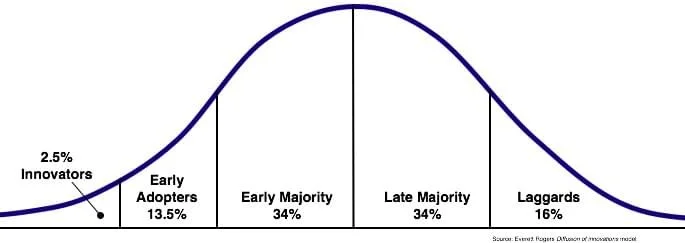
Technology Adoption Lifecycle
Avoiding Initiative Fatigue with New Technology
Initiative fatigue, also known as change fatigue or innovation fatigue, refers to the feeling of exhaustion, disengagement, or resistance that individuals or organizations experience when they are inundated with constant initiatives, changes, or innovations. It manifests as a sense of overwhelm and diminished motivation, making it challenging for individuals or groups to embrace or sustain new endeavors effectively. This is why it’s important to understand the current initiatives happening at your campus before introducing new technologies.
One source that discusses initiative fatigue is the book The Corporate Culture Survival Guide by Edgar H. Schein. Schein, a renowned organizational psychologist, delves into the complexities of organizational culture and change management. In his book, he discusses the challenges associated with implementing change initiatives within organizations, including the phenomenon of initiative fatigue.
According to Schein, initiative fatigue arises when organizations fail to adequately manage the pace and volume of change. He emphasizes that constant upheaval can lead to employee burnout, decreased morale, and ultimately, resistance to change. Schein argues that while change is essential for organizational growth and adaptation, it must be implemented thoughtfully and with consideration for its impact on individuals and the broader organizational culture.
Initiative fatigue can also be observed in various industries and contexts outside of organizational settings. For example, in the realm of technology adoption, individuals may experience fatigue when confronted with a barrage of new tools, platforms, or updates, leading to decision paralysis or reluctance to engage with new innovations.
In essence, initiative fatigue underscores the importance of balance and strategic planning in driving change and innovation. By recognizing the signs of fatigue and implementing measures to mitigate its impact, organizations and individuals can navigate change more effectively and sustainably, fostering a culture of resilience and adaptability.
Reference:
Schein, E. H. (1999). The Corporate Culture Survival Guide: Sense and Nonsense About Culture Change. Jossey-Bass.
Summary
Understanding the 5 Stages of Technology Adoption and Avoiding Initiative Fatigue offers valuable insights into the dynamics of innovation diffusion. Whether you're a developer seeking to market a new product to the higher education community or a consumer evaluating a technological trend, recognizing where innovation lies on the adoption curve can inform strategic decisions. By catering to the needs and preferences of each adopter segment, stakeholders can navigate the complex terrain of technology adoption and drive meaningful change in their organizations.
Again, the goal is to adopt new technologies that increase enrollment, improve retention, or offer better customer experiences for students and faculty. However, if these initiatives are not launched with the support and involvement of leadership who give clear expectations you may have just purchased a very expensive distraction to your goals of serving students. Be intentional with new technology adoptions at your institutions. As we continue to witness the proliferation of groundbreaking technologies, the principles outlined by Everett Rogers remain as relevant as ever, guiding us through the evolving landscape of innovation.
For more information or to schedule enrollment training or technology adoption at your campus contact devon@higheredcircle.com